
History won't judge us by what we recorded — it will judge us by what we did
Inside this month’s edition: Key lessons from FT Strategies The Local News Playbook; Altavoz Lab's “Deeply Rooted and Rising” approach to supporting community-rooted journalists; why WhatsApp isn’t social media — it’s infrastructure.
Welcome to the very first edition of Audience Almanac — a monthly field guide for community-first publishers navigating this moment with urgency, creativity and care.
Each month, I’ll share what I’m seeing across the field: practical playbooks, smart models worth adapting, funding opportunities on our radar, and reflections on what it takes to build journalism that’s truly of the communities we serve.
Think of it as a resource you can read in 10 minutes, forward to your team, and return to when you need something useful. And I want to start with one idea I can’t shake right now.
I spoke at the Lenfest Local News Summit last month, on the heels of another fatal ICE shooting, and kept coming back to this: Journalism can’t just be a witness right now. People need it to be a partner.
There’s a difference between documenting what’s happening and actually showing up in ways that help communities navigate it — with information that’s timely, useful and grounded in real needs.
Community-first publishers have been leading the way here for years: listening before publishing, building with their audiences and treating journalism as a form of mutual aid. For them (for you!), this approach isn’t optional. It’s the work.
You can find my my full remarks (and for insights from Austin’s mutual aid ecosystem) over at the Lenfest Institute: For journalists, this moment will not be defined by what we choose to record, but by what we choose to do.
Now, on to this month’s Almanac entry: a playbook that gets right at how to sustain community-first work over the long term.
📋 The Almanac Playbook: the “value loop” every local publisher should know
This month's must-read: FT Strategies just released The Local News Playbook: Creating Value for a Sustainable Future, new research produced in partnership with the Knight Foundation. It draws on interviews with newsroom leaders across nine countries and FT Strategies' experience working with over 1,000 news organizations globally. And the core framework is something every independent publisher should pin to their wall.
The Local News Value Loop: The playbook's central argument is that sustainable local news isn't built on any single revenue stream or editorial strategy. It's built on a reinforcing cycle between four things: relevance, audience engagement, revenue, and organizational capacity — and back again. When trusted journalism earns community time and attention, it unlocks the resources needed to invest in stronger reporting, deeper relationships and long-term resilience.
Underpinning this loop are five value drivers:
- Community connection — Reporting that is closely aligned to local needs and civic life. Not just covering your community, but being of your community.
- Direct relationships — Built through owned channels: newsletters, messaging services (yes, WhatsApp counts), events. Not rented audiences on social platforms (emphasis mine 😅).
- Revenue balance — Income drawn from multiple sources: reader revenue, advertising, services and philanthropy. No single funder or revenue stream should make or break you.
- Mission alignment — Editorial purpose and commercial decision-making reinforcing one another. Your business model should reflect (even reinforce) your values, not compete with them.
- Intelligent innovation — Responsible use of data, automation and AI to support newsroom capacity, not replace editorial judgment.
💭 Reflect on this: Take 15 minutes and score your own organization against these five drivers. Where are you strong? Where's the gap? That gap is where your next strategic investment should go. And if you're a funder reading this: the playbook has a whole section on how philanthropy can better support the long game — longer-term funding approaches, shared services and leadership development. Download the full report from FT Strategies »
✨ This Month’s Field Model: Altavoz Lab’s ‘Deeply Rooted and Rising’ Approach
Speaking of leadership development, if you want to understand what it looks like to invest in the people behind community journalism — not just the stories — please check out what Altavoz Lab is building.
Founded by award-winning investigative journalist Valeria Fernández, Altavoz Lab mentors and strengthens trusted local journalists who are deeply embedded in historically underserved communities. Their model redefines what career advancement looks like: not moving away to bigger markets or into management tracks, but growing in influence while staying rooted in place.
Since 2022, Altavoz has supported 17 fellows across the U.S. and Puerto Rico, producing award-winning investigations that have led to real policy changes — from improved rights for pregnant students to the installation of air-quality monitors in environmental justice hotspots. They are now working to scale their "Deeply Rooted and Rising" model — a phased, three-tiered career pathway: short-term community fellowships (7 months), extended fellowships (12 months), and eventually multi-year newsroom residencies.
What makes Altavoz different from traditional journalism fellowships? Their non-extractive, collaborative approach caters to journalists, partner news outlets and solopreneurs, treating retention as a systems problem rather than an individual one. They treat a reporter's lived experience and cultural fluency as strategic assets, not boxes to check.
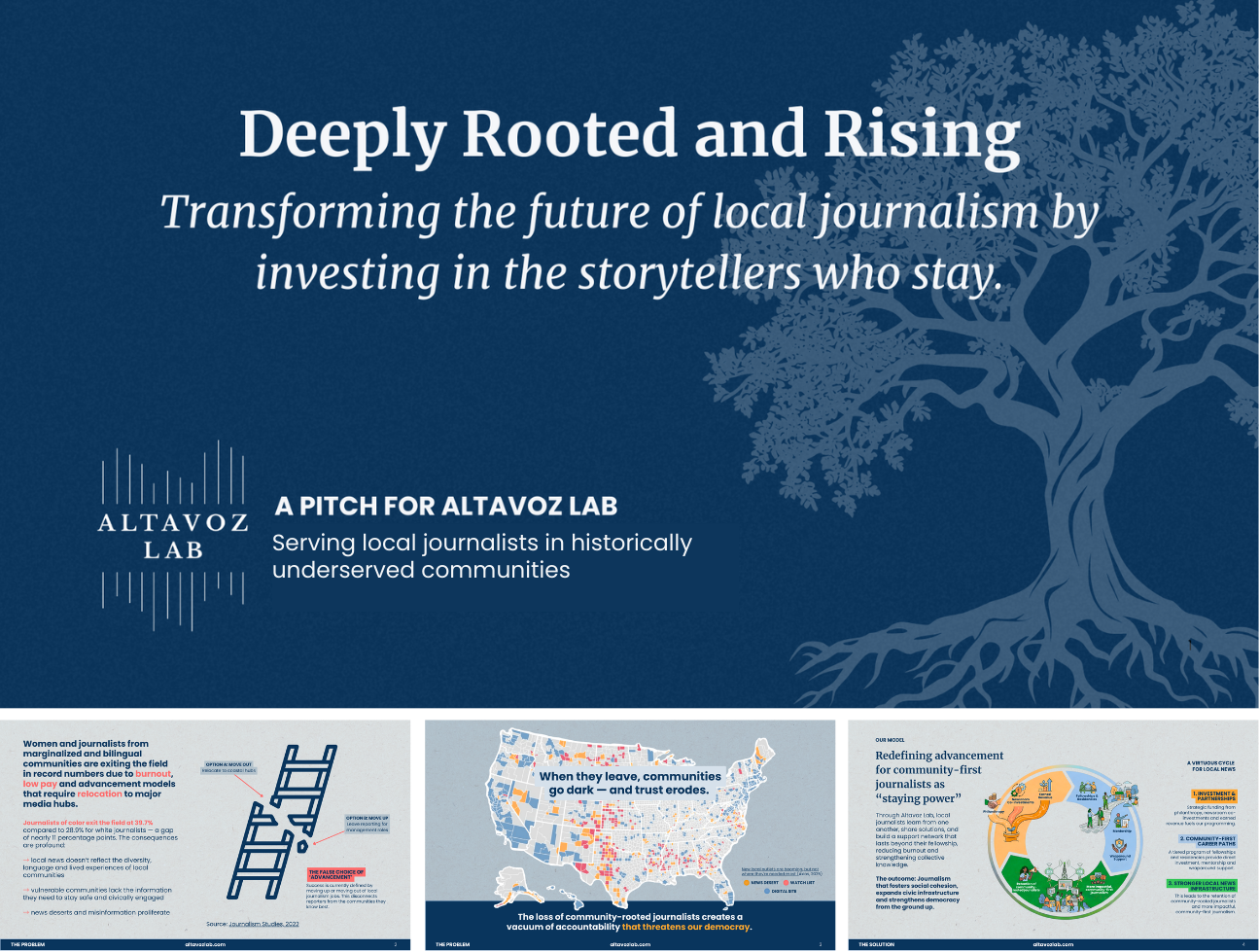
Full disclosure: Agencia supported Altavoz Lab in refining their pitch narrative — clarifying their value proposition, strategic positioning and roadmap for revenue sustainability as they seek multi-year investment to scale. It's the kind of strategic communications work we love doing: helping organizations with powerful models articulate their impact so funders and partners can see what we see.
Right now, Altavoz Lab has two open opportunities:
- 2026 Community Journalist Fellowship: Paid fellowships with mentorship, engagement funding and bilingual support for local reporters. Applications close February 16.
- 2026 Nick Oza Visual Fellowship: A $15,000 fellowship for documentary photographers rooted in underrepresented communities in the Southwest. Applications close February 23.
💰 Funding Forecast
Deadlines are coming fast. These are a few of the funding opportunities and resources on our radar for February and March (nearest deadlines flagged 🚨).
- 🚨Project C Creator Cohort at ONA26: 10 slots for independent, community-level creator-journalists to attend ONA26 in Chicago (March 30-April 1). Includes free registration, ONA membership, up to $1,000 travel stipend, and a coaching session. Deadline: Feb. 17 | Apply here.
- 🚨DDIA Latinos, Media, and Democracy Program (LMDP), The AI Edition: An 8-week, no-cost capacity-building program for Latino journalists, content creators and trusted messengers. 20 participants selected. Covers AI tools for prompt engineering, content analysis, verification, and ethics. Kicks off with an in-person workshop in D.C. on April 28-29. Deadline: March 1 | Apply here.
- CPJ/IWMF U.S. Journalist Rapid Response Fund: A brand-new emergency fund for journalists facing safety threats, launched last week by the Committee to Protect Journalists and the International Women's Media Foundation. Provides digital/physical security support, legal risk assessment, and newsgathering assistance. Rolling applications | Apply here.
- RJI Emergency Grants for Journalists in Crisis: The Reynolds Journalism Institute is tracking and curating emergency resources for journalists in crisis, including IFJ Safety Fund grants for threats, violence, and detention. | See the full list.
- Fund for Investigative Journalism Spring Cycle: Grants of $2,500-$10,000 for investigative reporting. Deadline: April 27 | Details here.
Know of a grant or opportunity we should feature? Hit reply to tell us about it.
🤝 From the Field: Builders & Doers

This month we're launching a new Q&A series spotlighting consultants, builders and operators doing smart, replicable work in community media.
Meet Juan Andrés Muñoz, Founder of Pamplonews, a WhatsApp-first local news operation in Spain that's rethinking how publishers reach Spanish-speaking audiences. Juan's big insight? WhatsApp isn't social media — it's infrastructure.
“U.S. publishers keep waiting for WhatsApp to ‘prove itself’ the way they waited on Twitter or TikTok, but that's the wrong mental model,” Juan told us. “WhatsApp is closer to SMS or email — it's how people actually communicate every single day. The biggest mistake is treating it like a nice-to-have distribution experiment instead of a primary communication channel.”
Pamplonews uses WhatsApp Communities (not groups, not channels) to land their daily newsletter directly in subscribers’ main chat interfaces — right alongside messages from family and friends. Juan's team built a custom CMS modeled on platforms like Beehiiv, but optimized for WhatsApp's unique constraints: mobile-first formatting, scheduled sends and analytics that track delivery, read receipts and click-throughs.
On revenue, Juan keeps it real: “Your first goal shouldn't be direct monetization. Spend your first 6-12 months aiming for 500-1,000 engaged local subscribers and demonstrating that WhatsApp is a viable distribution channel. Then, indirect monetization — local business partnerships, event sponsorships — is your lowest-hanging fruit.”
For U.S. publishers serving Latino and immigrant audiences, the implications are enormous. WhatsApp is already how many of your readers communicate daily. Juan’s work shows how publishers can turn a WhatsApp‑first strategy into real revenue through high‑value local sponsorships, events and services. Read the full Q&A on thisisagencia.com »
1️⃣ Thing to Try This Month
How are you communicating your mission in practice? Pull up your homepage right now. Look at it like a first-time visitor would. Can they tell in five seconds who you serve, what you do and why it matters?
If the answer is “kind of” or “not really” — you’re not alone. Most publishers lead with their latest stories instead of their purpose. But your homepage isn’t just a landing page. It’s your front door.
📝 Try this: Write one sentence that answers “Who do we serve and why does our journalism matter to them?” Put it at the top of your site.
Then, send your homepage to three people (including at least one that doesn't already know your org well) and ask: “What do you think this newsroom exists to do?” Think of this less as a performance test and more as a listening exercise. The feedback is the data.
Audience Almanac is a monthly newsletter from Agencia Media — delivering practical frameworks, funding leads and community-first models for publishers doing the work.
— Have something we should feature? Just reply to this email.
— Know a publisher who could use this? Forward it along.
Thanks for reading!
Amanda ✌️